Where do you find your salvation?

A reflection for Ash Wednesday 2024 by Brother Thomas Aquinas Hall, OSB

“It’s scary, but still in everything about you I find salvation.”

This statement with which I start this reflection with is a lyric from a recent song. But what song is it from? Is it from a new religious hymn? No. Is it from a song by a popular American singer? Also no. Is it from a song from someone with a Youtube channel, or TikTok?  Again, no.

So where does the lyric in question come from?

It comes from the opening song of the current season of the romantic comedy anime The Dangers in My Heart and it’s been on my mind a lot recently.

One of these reasons is because this year Ash Wednesday falls on Valentine’s Day.  While most people wouldn’t really think much about this, I think it’s a big deal and an opportunity to reflect on what love really means or what it can also mean.  As I said in one of our recent all-school convocations, if I had control over it, I would make Valentine’s Day fall on Ash Wednesday every year in order to reflect on what love really means or what it can also mean every year.  But since I can’t do that, I guess I’ll have to settle on reflecting on this occurrence this year.

I return to the question posed by the song lyric above: “Where do you find your salvation?’  In The Dangers in My Heart, the lyric refers to a guy finding salvation in a girl, but he finds it to be scary since it involves him changing and being encouraged by this girl to try new things.
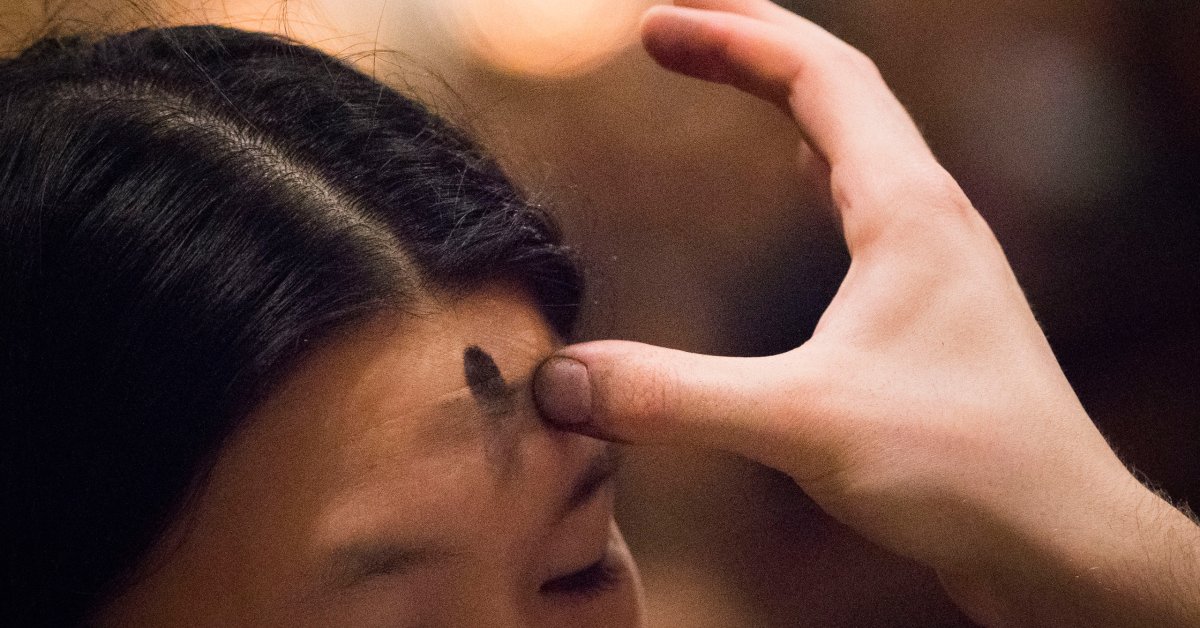
That’s the Valentine’s Day answer to the question. But where else can salvation be found? Another example of where salvation can also be found is in the Mass.  In the Mass, there are opportunities to find salvation in not a girl, but in Christ, whether that be in the readings, the imposition of ashes (in the case of an Ash Wednesday Mass), and in receiving the Eucharist.  Trying new things isn’t exactly what this salvation is about.  It’s about how the encounter with Christ, no matter how it happens, can change you, which makes this salvation a mystery.

The fact that the salvation that can be found in the Mass is a mystery is most likely why people prefer the usual way to celebrate Valentine’s Day: Buy this for the person you love. Or you can get them that. Or you can get them this and that. Celebrating Valentine’s Day the usual way is easy and straightforward; the mysterious salvation found in Christ unfolds over a lifetime.

This Valentine’s Day, one might consider showing their loved one what love really means by celebrating Ash Wednesday instead. This option might not sit well for everyone, and isn’t a desirable option since it goes against what society says about Valentine’s Day, but it’s still an option.  An option that I think is worth reflecting on, especially when Valentine’s Day falls on Ash Wednesday, as it does this year.  

Brother Thomas Aquinas Hall, O.S.B., is a monk of Newark Abbey. He regularly posts reflections on anime and manga at https://animeandmangalectio.blogspot.com/


Bearing the Marks of Christ: A Reflection on the Meaning of Suffering through the Wounds of Jesus

By: Fr. Maximilian Buonocore, O.S.B.

When we think of saints like Padre Pio of Pietrelcina and Francis of Assisi, we think of the stigmata which were a manifestation in the flesh of these saints of the sacrificial mercy of Jesus realized in a very high way in them. But each and every one of us is also called to bear the marks of Christ in our body and soul. The stigmata by which we, as ordinary Christians, manifest the sacrificial mercy of Christ in the flesh is our compassion for those who suffer, our joyful readiness to bear suffering ourselves, and our joyful readiness to come to the service of others in need. 

We are called to bear the wounds of Christ by suffering with him. Although Christ’s death on the cross was final, his redemptive suffering is ongoing. St. Paul (Romans 6:10-13) makes clear that the death of Christ was once for all, perfect in fulfilling its purpose: “For we know that since Christ was raised from the dead, he cannot die again; death no longer has mastery over him. The death he died, he died to sin once for all. . .” But we also know that Jesus’ redemptive suffering continues vicariously through us and all who suffer across the ages. When Jesus invites us take up our cross daily to follow him (Matthew 16:24-26), he invites us to share in his ongoing redemptive suffering for sin as a way of participating in his evangelical mission of drawing souls to his Father as adopted children and heirs of God (Romans 8:17): “The Spirit itself bears witness with our spirit that we are children of God . . . and fellow heirs with Christ, if only we suffer with him so that we may also be glorified with him.” But, we are assured that bearing the wounds of Christ, suffering with him, comes with the redemptive power of the resurrection (Philippians 3:10): “. . .that I may know Him and the power of His resurrection and the fellowship of His sufferings, being conformed to His death. . .” “Therefore I am well content with weaknesses, with insults, with distresses, with persecutions, with difficulties, for Christ’s sake; for when I am weak, then I am strong.” (2 Corinthians 12:10)

Jesus suffers vicariously through us in all of our sufferings and in the sufferings of all those who suffer in the world. Henri Nouwen articulated this mystery so profoundly when he said:

 “We have come to the inner knowledge that the agony of the world is God’s agony. The agony of women, men and children during the ages reveals to us the inexhaustible depth of God’s agony that we glimpsed in the garden of Gethsemane. The deepest meaning of human history is the gradual unfolding of the suffering of Christ. As long as there is human history, the story of Christ’s suffering has not yet been fully told. Every time we hear more about the way human beings are in pain, we come to know more about the immensity of God’s love, who did not want to exclude anything human from his experience of being God. God indeed is Yahweh Rachamin, the God who carries his suffering people in his womb, with the intimacy and care of a mother. This is what Blaise Pascal alluded to when he wrote that Christ is in agony until the end of time. The more we try to enter into this mystery the more we will come to see the suffering world as a world hidden in God.” (Christ of the Americas)

This is why St. Teresa of Calcutta invites us to see in the poor, and in all those who are suffering, Christ on the cross saying “I thirst,” and invites us to satisfy that thirst through deeds of love. Our sacrificial works of charity are not carried out in order to get us into heaven, but they are the means by which heaven gets into us who are members of that “suffering world hidden in God”. Our works of charity guarantee that our heart dwells in heaven even while our body and mind dwell on earth engaged in the business of the world.

The prophet Isaiah (Isaiah 9:11, 16, 20; 10:4) repeats the phrase: “. . .and his hand is still outstretched!” In this passage, Isaiah expressed the punishing - the wounding effect - of his outstretched arm, but he adds elsewhere with great emphasis that the ultimate effect of his outstretched arm is healing and forgiveness and mercy. In Old Testament times, the Lord stretched out his arm with a punitive effect toward the sinner in order to gain mercy for the most vulnerable and suffering - for the widow, the orphan and the stranger - while at the same time humbling the sinner so that he would become open to the redemptive mercy of the Lord. Likewise, in New Testament times, Jesus stretches out his arm to us, inviting us to take up our cross in self-sacrifice for the sake of others, especially the suffering and needy, inviting us to take up our cross daily to follow him, bearing his wounds in our body and soul, interceding with him to the Father, to gain mercy for the poor and downtrodden, while, at the same time, his same outstretched arm provides strength and healing to our own sinful soul, humbling our hearts in preparation for receiving his redemptive mercy.

After his resurrection Jesus stretched out his arm so that Thomas and the other apostles could touch his wounds now glorified. Jesus did not not say to Thomas, “Touch my side.” No. Jesus said to Thomas, “Put your hand into my side.” He wanted Thomas to do more than touch his wounds. He wanted Thomas to touch his heart, and thereby to touch the heart of God. Jesus invites us daily, also, to put our hand into the wound in his side, to touch his heart, so as to touch the very heart of God, and thereby to become channels of the excruciating love that flows from the heart of so loving a Father, through the heart of Jesus, flowing through his wounded side. The wounds of Jesus are an opening in creation to the heart of God. They are an opening to touch the heart of Jesus, and thereby to touch the heart of God. 

The wound in Jesus' side is an opening to a most intimate heart-touching-heart relationship between God and human beings. Whenever I put my hand into the side of Christ, reaching with the hand of charity, to touch his heart, the water and blood of grace and mercy flow through me into the world. In contemplating the wounds of Christ, I can see how, with a lance, a human being opened up the passageway between time and eternity; how, with a lance, a human being pierced the divine heart of love, piercing the heart of a man nailed to a cross, that the water of divine holiness and the blood of divine goodness and love may flow forth from the divine heart of love of the Father, through the wound in the heart of a human being, into men and women to sanctify them, to quicken them with true and eternal life.

It is in this way that Jesus invites us, with outstretched arms, to touch his wounds, so that we may be healed and that we may offer his healing touch to others. Like the apostles, I feel the wounding of the Lord’s outstretched arm as I take up my cross in order to, as St. Paul said, “fill up in [my own] flesh what is lacking in the afflictions of Christ on behalf of his body, which is the Church.” (Colossians 1:24) And it is thus that I, like St. Paul and the other apostles, bear the marks of Jesus on my body.” It is thus that I become a channel for the healing flood of grace and mercy which flows forth from his glorified wounds to flow into the world. Whenever I perform an act of mercy, a self-sacrificial deed of charity, an act of forgiveness, I touch the wounds of Christ, and I gain the healing grace that pours forth from his wounds not only for myself, but for others as well, because I am in that moment an earthbound channel of the heavenly channel of his wounds. Thus, every person who is living a truly evangelical life bears the marks of Christ in his/her body and soul, and bears the evangelical message, also forecast by Isaiah (9:1-2): “The people who walked in darkness have seen a great light; Upon those who lived in a land of gloom a light has shone." You have brought them abundant joy and great rejoicing. The suffering of the cross, of the wounds, is not for suffering’s sake, but for the channeling of mercy into the world.

Because of the power of the resurrection in the wounds of Christ which we bear through our suffering, we are able to embrace great suffering because this suffering, joined to the wounds of Christ Crucified, can now serve for us as a vehicle of contemplation: a vehicle of the contemplation of the profound compassion and faithful mercy of God the loving Father, expressed through his incarnate Word, who embraced death on the cross as an expression of excruciating love. In our own suffering, we contemplate the wounds of Christ, to see how Jesus was pierced with sorrow and deep compassion for the sins which keep souls from being open to God’s love, and we ourselves become pierced with Christ with that same sorrow for sin and deep compassion for souls.

In the Presence of the Living Christ: Reflections on Abbot Melvin's 48th Anniversary and the Nativity of Mary

A sermon given by Fr. Luke Edelen, O.S.B.at conventual Mass on September 8, 2021, the Feast of the Nativity of Mary

It may be I am simply influenced by my American experience, but it seems that there may be something to the sense that September begins a “new year.” Not only is there Labor Day, the ‘unofficial’ end of summer, but there is also the customary opening of a new academic year - for us at St. Benedict's Prep School, the ‘Fall Term’ - and this year 2021, the earlier occurrence of Rosh Hashanah (“the head of the year”), the Jewish New Year holy day, heightens that feeling.

For us, as monks of the Benedictine Abbey of Newark, this 8th day of September also opens another year as it is the anniversary of the election of Abbot Melvin in 1973. On this 48th anniversary, he begins the 49th year of his abbacy.

Abbot Melvin (seated) and
Fr. Luke (standing)

Likewise today's liturgical celebration of the birth of the Mother of Our Lord Jesus Christ is a “new year” event. The first of September is the Indiction, the beginning of the Church’s year in the Byzantine tradition of Eastern Christianity, and Mary's birthday is situated at this time in the calendar as the beginning of the more proximate unfolding of God's plan for renewing humanity and his creation in the mission of the Son. Mary's birth, as the specially chosen and prepared instrument for God's daring design for the healing of men and women and the world through the Incarnation, is hailed as “the dawn of our salvation” because it means a decisive step forward in the realization of his purpose. The divine “long game” referred to in the chosen Scriptural readings from the prophet Micah (5:1-4a) and from Paul's letter to the Romans (8:28-30) begins implementation.

It was this faith-filled insight that led Pope Sergius, a Syrian, to introduce this celebration to the church in Rome in the 7th century from which it spread to other churches in the West. In the 19th century, the date served to confirm the fixed observance of Mary's conception nine months earlier on the 8th of December.

Speaking of dates and years and events in time affords me the opportunity to reflect with you further in this vein.

Our monastery became an Abbey again by a decree on November 21, 1968, the Presentation of Mary. Yearly, we honor Mary Immaculate, our patroness since our foundation in 1857, on the 8th of December. Our principal work, our apostolate, the School, was forced to “suspend operations” in June 1972, but we re-opened in hope and with renewed purpose on July 2, 1973. Our second abbot was elected in 1973, a time that had the feeling of 'newness' in the midst of uncertainty, and with divine help, determination, no little support from alumni, friends and benefactors, an energetic and enthusiastic headmaster, and a committed and united community, staff and faculty, the intervening nearly fifty years have seen much growth and physical changes, additions, buildings, renovations and enhancements. No one could have foreseen the developments that have ensued. Even at present, challenged by the persistent presence of a pandemic, these continue: the School embraces students from K-12 numbering nearly a thousaand, a Girls’ Prep division was initiated in 2020, the monastic community has welcomed new young members, and two separate but mutually supportive Corporations for monastery and school, respectively, are soon to be formed at the Abbey.

This briefest sketch leads me now to speak about the one celebrating his feast or name day today--in simple truth--because the dramatic outward changes are only part of the story of the last 48 years in which the monk elected by his brothers on this day had a crucial, if not exclusive role.

In my perspective, the operative insight, the guiding principle of the Abbot chosen then was that if Newark Abbey and its chief re-appropriated historic apostolate were to flourish, it had to be a monastery “for real,” as we say here in Brick City. In his teaching (referred to by St. Benedict in his Rule as doctrina) and by his example, Abbot Melvin has unswervingly emphasized and called the monks to the same, while doing as Benedict advised--adapting his teaching and his guidance to “a variety of characters” (I being one)--and yet giving the strong something to strive for, and the weak nothing to shrink from as too hard. For which reason, we owe you, Abbot Melvin, thanks for your shepherd’s care and wish you every blessing on this your double festivity: name day and anniversary.

At some time in the not so distant years, one of our senior monks, Father Boniface, remarked that he thought the community should begin to observe any Saturday on which it was possible to do so as a day to honor Mary in our common prayer, according to an old custom in the Church. Conscious of her care for her Son's disciples as Jesus had requested when he was dying on the cross, we readily agreed. It is a frequent recurring reminder through the year not only of the intercession of the Mother of the Lord for this community in particular and its life and work, but also of her example as a willing participant in God's design. Mary is the shining figure that illumines the mystery of grace: God is always calling and choosing human instruments to accomplish, in diverse times and places, his purpose, while also giving what they need to accomplish it.

This has clearly been the underlying current in the passage of the nearly fifty years of your abbacy. In and with, and by, the working of Providence, and through the gifts of divine grace, and together with the monastic community and the always larger community connected to it, in your vital role and faithful leadership, you have made it possible for us to allow the living Christ to exercise his presence, prolonging the mystery of the Incarnation, just as Mary's 'yes' opened the way for it at the beginning. It may seem incredible to us, but God be praised, we have been told many times and by many people--if in not so exact words--that it is so. The whole has been greater than the sum of its parts. The West African Igbo proverb says: “It is not those who are dancing that one should ask how the dance is going.” Those who have observed the dance, and those who have joined in it, have spoken clearly.

May the example of Mary in her life, by her loving prayer and the amazing power of the Spirit who overshadowed her, continue to empower you and us in the service of Christ the true King and his kingdom here in Newark.

"Everything else fell away:" The Pursuit of God in the Life of St. Bruno

By: Br. Bruno Mello, nO.S.B.

O God, who called Saint Bruno to serve you in solitude, grant, through his intercession, that amid the changes of this world we may constantly look to you alone.

Four years ago today, the feast day of St. Bruno, I heard these words echo through the oratory of a former Carthusian monastery nestled in the foothills of the Alps. Located in Gaming, Austria, the sprawling monastery stands rooted on the valley floor, a maze of white washed walls topped by red-shingled roofs peaked in steep triangles. Climbing heavenward from the vast charterhouse is the oratory, which stands nearly twice as tall as any building connected to it. Everything about the church is disproportionally vertical: its walls reach higher that the summits of the surrounding rooftops, the angle of the roof is steeper than any other on the property, and an airy stone spire rises to a point, proclaiming to the entire valley that this is the place where Heaven meets earth. The whole outward appearance of the church proclaims this truth: it seems as if an invisible hand has grabbed hold of the spire and pulled upward, vertically stretching the entire oratory. Even in the heavy shadows of the surrounding mountains, the oratory effortlessly soars upward.

Within the church, the same message is apparent in the architecture. Sitting in a simple wooden pew, I would gaze upward, following the white washed walls to where they meet the unexpectedly high ceiling and give way to floral patterns and frescos. Looking down from Heaven upon the worshippers in the pews below is St. Bruno, whose life is depicted in three huge frescos adorning the oratory ceiling. One in particular always caught my eye: the apotheosis of St. Bruno, ascending into Heaven on the hands of angels, his head surrounded by seven stars.


Before I arrived in Austria as a twenty-year old college student, I was vaguely familiar with St. Bruno. I had seen the film Into Great Silence, read They Speak By Silences, and knew St. Bruno as the founder of the Carthusian Order. But it was sitting in the cavernous oratory at the Gaming Charterhouse that St. Bruno captured my imagination. Like the spire that pulled the church upward, the paintings of St. Bruno on the ceiling seemed more like portals than decorations: they were windows into an invisible reality, one which St. Bruno lived in all his life.

St. Bruno was born in Cologne (present-day Germany) in the year 1030. We know little of his childhood, but historians find him again as a young man, ordained a priest around the age of 25 and appointed head of the cathedral school in Reims (present-day France) at the age of 26. He gained great renown as a teacher, especially for his lectures on the Psalms. In his forties, he was appointed chancellor of the Archdiocese of Reims, which put him in conflict with the corrupt, simoniac archbishop, Manasses. St. Bruno's opposition to Manasses cost him greatly and he was forced to flee Reims until Manasses was deposed by Pope Gregory VII. St. Bruno's courageous stand against ecclesiastical corruption earned him great popular acclaim and he quickly became the top candidate to replace Manasses as Archbishop of Reims, the most prestigious diocese in the region. The Lord, however, was calling Bruno to serve the Church in a different way.

Leaving Reims, Bruno sought to live as a hermit, first under the direction of St. Robert of Molesme (one of the founders of the Cistercian Order). After some time in Molesme, Bruno left with six companions and traveled to the French Alps, where in 1084, he established a hermitage in a remote mountain wilderness in the Chartreuse Mountains (yes, there is a connection to the drink). At the Chartreuse, Bruno and his companions lived lives of prayer and solitude, coming together for common prayer only a few times a day, and spending most of their hours in silent contemplation and manual labor. This was Bruno's vocation, but it was short lived, as he was summoned to Rome to serve as advisor to Pope Blessed Urban II, one of his former students.

Once again resisting worldly honors, St. Bruno begged to be allowed to return to his solitary life. Bl. Urban II consented, and Bruno was permitted to found another hermitage in Calabria (present-day southern Italy), though his surviving letters make it clear that he remained affectionately attached to his brothers back in the Chartreuse. Bruno lived the rest of his life in Calabria, where he died in 1101. Though Bruno never intended to found a religious order, after his death, his followers recorded the practices of his communities in the Consuetudines, the founding document of the Carthusian order. Today, the Carthusian Order is recognized as the strictest monastic order in the Church, with about 400 monks and nuns living in 23 monasteries (called charterhouses) across the world.

It seems strange that a man who fled worldly honors should be depicted in a gloriously Baroque apotheosis scene: eyes raised to heaven, hands outstretched, angel garments swirling in the wind. But St. Bruno is full of paradoxes: a man of great worldly potential, who left everything to seek God alone, who was then raised up by God to be a model of holiness for the whole world. This model that the life of St. Bruno demonstrates is not fleeing, but seeking. St. Bruno, in the midst of drama and political intrigue, never backed down from a challenge. He faced down his own archbishop and was an advisor to the Pope. His life as a hermit was not as escape. It was a pursuit. He fixed his eyes on God and ran towards Him, never wavering, and everything else fell away. 

Bruno was not a man afraid of the world; he was a man deeply in love with Jesus Christ. One of the most common Scripture verses associated with the Carthusians is from the Prophet Jeremiah: "You seduced me, Lord, and I let myself be seduced." St. Bruno allowed himself to be seduced by God, to be drawn away to the wilderness, to silence, to God alone.

When a man becomes a Benedictine monk, his abbot often gives him a new name as a sign of conversion. I thank God that Abbot Melvin gave me the name Bruno. Four years ago, as I prayed in the Gaming Charterhouse, gazing up in awe of the God who raised St. Bruno to such heights, never did I imagine that I would become a monk bearing the name of such a great saint. Any time someone addresses me by name, I am reminded that my life should be an unending pursuit of the Absolute, the Incarnate, the Good, the Beautiful, the Lord, the Sweet, the Merciful, Who is that than which nothing greater can be conceived, Who is infinitely knowable, Who holds the universe in the palm of his hand, Who appears under the guise of bread and wine. St. Bruno was a man immersed in the mystery of the God who transcends all time and space but still speaks to us by name. He is the model monk, who lived his life in headlong pursuit of his only Love. 

On this feast of St. Bruno, please pray for all the monks of Newark Abbey, that we may seek the Lord with our whole hearts and be drawn deeper into intimate love with God everyday.

Photo credit: “Gaming Kartäuseekirche02” by BSonne, used under CC BY 4.0 / Filtered from original)


"Around Him tempest rages:" Finding God in the Storms of Life (literally)

By: Br. Bruno Mello, nO.S.B.
August 11, 2021

The monks celebrated the Feast of St. Lawrence on Monday night with fraternity and conversation around the dinner table. Unseen to us while we ate, storm clouds crested the Watchung Mountains, ominously bearing down on the city of Newark in the plain below. By the time we gathered in the Abbey Church for Vespers the monastery was engulfed by black clouds and the summer evening sunlight had turned as dark as night.

Light showers quickly turned into sheets of pelting rain. As we finished the opening hymn, a couple monks frantically closed the open clerestory windows throughout the church's nave. Once they returned to their seats, an eerie stillness settled upon us in the choir stalls. Outside, the world was in tumult. Through open ground floor windows, I could see rain pouring down. Flashes of lightning reflected off the sheen of nearby buildings so that every bolt appeared to strike the street right outside the church. Loud and almost constant thunder shook the church. Inside, the monks prayed as if nothing was amiss:

They surrounded me, the snares of death;
    the anguish of the grave has found me;
        anguish and sorrow I found.
I called on the name of the LORD:
"Deliver my soul, O LORD!"   

The last line was drowned out by the roar of thunder. The storm couldn't be kept out. With each lightning strike the sound system crackled. The monks strained to sing loud enough to hear ourselves over the chaos of rain of the roof, electricity in the air, and sirens in the street. We were engulfed by the storm, yet we kept vigil, praying under the soft yellow light of our wooden floored church.

I couldn't help but think that our little church was a microcosm of the entire Church: a respite of peace in a distressed world, a small ship making her way through the raging storm, a community of love in the midst of destruction - surrounded but not overwhelmed.  

The storm outside seemed to represent something evil. It was a temptation from the devil to fill us with fear and anxiety (or to make us wonder, as I did briefly, "Did I leave my bedroom window open?"). The structure of liturgical prayer - the modal chanting, prescribed postures, and disciplined silences - was confronted by its exact opposite: the total chaos of a tempest.

When the we began the second psalm of Vespers though, that chaos was transformed into order, for at the very moment the organist began to intone the psalm, the sky erupted with a low roll of thunder of the exact same pitch. For a second, the low rumble of man-made organs pipes and the violent crash of nature were in perfect harmony, praising the Lord together. Suddenly the storm was not a threat to us - the storm was our partner in prayer.

Psalm 18 came to my mind instantly:

In my anguish I called to the LORD;
I cried to my God for help.
From His temple He heard my voice;
    my cry to Him reached His ears . . . .

He bent the heavens and came down,
    a black cloud was under His feet.
On a cherub, He rode and He flew;
He soared on the wings of the wind.

He made the darkness His covering,
    the dark waters of the clouds, His tent.
A brightness shone out before Him,
    with hailstones and flashes of fire.

The LORD then thundered in the heavens;
    the Most High let His voice be heard,
        with hail and coals of fire.
He shot His arrows, scattered the foe,
    flashed His lightnings, and put them to flight . . . .

From on high He reached down and seized me;
He drew me forth from the mighty waters.
He saved me from my powerful foe,
    from my enemies, whose strength I could not match.

And also a verse from Psalm 50:

Our God comes, and does not keep silence.
Before Him fire devours;
    around Him tempest rages.

As Christians, we are accustomed to the story of Jesus Christ and the humility of the Lord's incarnation. God became man and dwelt among us, His birth announced to shepherds, His body buried in a spare tomb, His resurrection witnessed by only a chosen few. To read these psalms about God coming to rescue His people amidst storm clouds and tempest ironically subverts our ideas about God as much as the Incarnation subverted expectations about the Messiah! 
 
So as I sat in my choir stall, patiently chanting ancient psalms and two thousand year-old canticles, I marveled that the storm around us - the storm that seemed to bring darkness and anxiety into our prayer - might be nothing other than the Lord's presence, surrounding us, consuming us, joining us in glorifying the God and Lord of all.

Our God is King of the Universe. Nothing is beyond His reach. He rides victorious on the storm clouds, He dies victorious on a cross. He is present - Body, Blood, Soul, and Divinity - in the Eucharist and He is present in the heroin addict on the nod at the steps of the church. He receives praise from the mouths of monks, He is glorified by rolling thunder.

St. Paul speaks of a future in which "God will be all in all." On Monday night I heard a clap of thunder sing the Lord's praise and discovered that future is nearer than I had first believed. 

The Meaning of the Liturgy: A Sermon on the Holy Sacrifice of the Mass

A sermon written by Fr. Benedict Bradley, O.S.B. (1867-1945) in 1942, published posthumously in 1950, and revised by Br. Bruno Mello, nO.S.B. in 2021.


Editor’s Note: In updating this spiritually edifying sermon for the twentieth-first century audience, I have made minor spelling, diction, and syntax edits, changed all Bible verses to the New Revised Standard Version, Catholic Edition translation, and added several emphases and explanatory endnotes. All edits are made with the purpose of elucidating Fr. Benedict’s original meaning and purpose, with the notable exception of passages in which Fr. Benedict explicitly refers to specific liturgical words and actions. In these places I have substituted such references with the corresponding words and actions from the Roman Missal promulgated by Pope Saint Paul VI in 1970 which contains the liturgical changes called for by the Second Vatican Council and is thus more familiar to most Catholics. Where this occurs, Fr. Benedict’s original wording can be found in the endnotes. All endnotes are my own.


Fr. Albert Holtz, O.S.B. is incensed by the deacon while offering the
Holy Sacrifice of the Mass on the 50th Anniversary of his priestly ordination
    The liturgy is the official public worship of the Church. It comprises the Holy Sacrifice of the Mass, liturgy in its highest sense, the administration of the other sacraments and sacramentals, and the Divine Office.

    What makes the liturgy so far superior to non-liturgical acts of worship, like the Rosary, the Stations of the Cross, and others highly approved and richly indulgenced? Wherein lies the difference? A brief explanation of the term liturgy will make it clear.

    Christ never separates Himself from His Mystical Body, which is the Church. He is the Head, and all baptized souls on earth, in heaven, and in purgatory are His members. In uniting Himself to His Mystical Body, the Church, He gives her His power of adoring, thanking, propitiating, and petitioning His Father. Thus the liturgy is Christ adoring, thanking, propitiating, and petitioning His Father through the lips and actions of the Church, that is, through the lips of all the living members of His Mystical Body, through your lips and through mine.

    The Holy Sacrifice of the Mass is offered to our Heavenly Father by Christ and His living members on earth, that is, by the souls in the state of sanctifying grace. We do not pray to Christ in the Holy Sacrifice, but Christ, our Head, in union with His members, worships our Heavenly Father. Hence the Holy Sacrifice is not a devotion to Christ, as many imagine, but Christ’s worship of His Father, in union with His members on earth. While it is only the living members of His Mystical Body on earth who offer the Sacrifice with Christ, the members of His Mystical Body in heaven are united with it in intercession, and the souls in purgatory share in its fruits. Thus the entire Mystical Body is in the Holy Sacrifice of the Mass.

Understanding the Mass

    In order that we may offer the Holy Sacrifice of the Mass intelligently, it is necessary that we understand what it is. Pope Pius XI (r. 1922-1939) pleaded for a fuller understanding of the liturgy, chiefly the Holy Sacrifice of the Mass, and a more intelligent participation in it, as the prime purpose of the Liturgical Movement (1). For centuries we have been speaking of the Mass. It would have been much better had we always called it the Holy Sacrifice of the Mass. If we had done so, the faithful would have always realized that there is a sacrifice in the Mass, and they would probably know what that sacrifice is. If you should ask the ordinary Catholic the question, “What is the Mass?”, you would get some strange answers. Many have no clear notion of what sacrifice means. They regard the Holy Sacrifice of the Mass as a devotion, like exposition of the Blessed Sacrament, Stations of the Cross, or a novena. It is much more; it is a sacrifice, religion’s supreme act of worship, the renewal of Christ’s Sacrifice on Calvary.

The crucifix is the best picture of the Holy Sacrifice of the Mass that we have. Look at the crucifix and you will see what the Church is renewing on the altar. It is to keep the priest’s mind fixed on the great act of worship he is performing that the Church requires a crucifix to be placed on or near the altar during the Holy Sacrifice (2). It should serve the same purpose for all the faithful, and it would be well for them often to raise their eyes to the crucifix during the Holy Sacrifice.

The crucifix is an important liturgical object, one which reminds us of the cause for our joy.
    And what does the crucifix represent? Not simply a human body hanging nailed to a cross. No, it represents more than that; it represents the death of our Lord, the moment of the world’s redemption. St. Paul says: He redeemed us by His death. The world was redeemed the moment our Lord died, and His death was His Sacrifice. When we speak of sacrifice in the liturgy, we mean the death of our Lord, the meritorious cause of our redemption. Insofar as His death is the consummation of His life, we can say that under the point of view of a sacrifice, His whole life is contained in His death, the ultimate consummative act. Hence the redeeming act, from the Incarnation to the Ascension, is sacramentally present in every Mass.

What the Mass Does

    Now, what does the Sacrifice of the Mass do? It makes present the death of our Lord. Our Lord Himself, through His minister, makes His death present on the altar. His death on the Cross was brought about by the separation of His Body and Blood. After the consecration, we have before us on the altar the Body and Blood of Christ sacramentally separated, the same Body and Blood that were separated on the Cross. At the Consecration in the Mass, our Lord, through the lips of His minister, pronounces the same words He pronounced at the Last Supper: This is my body—This is the chalice of my blood. At that moment, the substance of the bread is changed into the substance of His Body and the substance of the wine is changed into the substance of His Blood. We have on the altar the Body and Blood that Christ offered on Calvary, the Body and Blood of the Last Supper.

    Christ does the same thing at the Holy Sacrifice of the Mass that He did at the Last Supper, when He offered the Holy Sacrifice for the first time. At the Mass, we have the privilege of being present at the death of our Lord with all its divine efficacies, just as truly as our Blessed Mother had that privilege on Calvary. There is no essential difference between the Sacrifice of the Cross and the Sacrifice of the Mass. They are identical, for the sacrifice in each is the death of our Lord Jesus Christ.

    The Sacrifice of the Cross took place in a moment, the moment of our Lord’s death. At that moment the world was redeemed. At that moment Jesus Christ gained infinite merits for the salvation of all mankind. In the Mass, He gains no new merits, but He applies to our souls the merits gained on Calvary. This is the secondary reason why we offer the Holy Sacrifice of the Massto get the merits Christ gained for us on the Cross.

The Debts We Owe God

    The four debts that every man owes to God are adoration, thanksgiving, satisfaction, and petition. The debts of sin contracted by Adam and Eve and by all their children were paid by Christ’s death on the Cross. All the debts of the good thief dying at the side of his Savior were paid by Christ’s death. For this reason He said to the good thief: “Today you will be with me in Paradise.” He was saved and entered Paradise at once because Christ had paid all his debts. The Holy Sacrifice of the Mass, like the Sacrifice of the Cross, pays all our debts, when we bring to it the disposition of the good thief: total and perfect self-surrender, the disposition with which our Lord offered His Sacrifice on the Cross. The Sacrifice of the Mass is just as effective as the Sacrifice of the Cross, for both are the same. In the Mass, He still redeems sinners with plentiful redemption by applying to them the infinite merits of the Cross.

    Many Catholics do not know their position in the Holy Sacrifice of the Mass. They do not know that they go to Mass to offer the Holy Sacrifice. They go to Mass for the same purpose for which the priest ascends the altar; they go to offer the Holy Sacrifice with him. Remember always that it is Christ Himself who offers the Holy Sacrifice of the Mass through His minister at the altar, and He offers every Mass in union with all the living members of His Mystical Body on earth. So we go to Mass to do with Christ what He did on Calvary; we go to renew the Sacrifice of the Cross.

    In the early days of the Church, the faithful understood the Holy Sacrifice better than they do today, and, understanding it better, they knew how to offer it. The prime purpose of the Liturgical Movement is expressed in the letter of Cardinal Maglione to Monsignor Morrison, chairman of The Liturgical Week, held in Chicago, in 1940: “The Holy Father,” he writes, “would also have me assure you, dear Monsignor, of his gratitude for the constant interest you and your devoted helpers have manifested in this newest endeavor to bring American Catholics to a fuller understanding of the liturgy of the Church and to a more intelligent participation in it (3)."

Assisting at Mass

    The manner in which the early Christians assisted at the Holy Sacrifice of the Mass differed widely from the way in which most of the faithful assist at it today. Instead of taking an active part in offering the Holy Sacrifice, as they did, most Catholics content themselves with being passively present. It was to correct this error that Pope Saint Pius X (r. 1903-1914) wrote his encyclical on Church Music (4). One sentence of that famous document is quoted in every work that speaks of participation in the liturgy. It reads as follows: “The primary and indispensable source of the true Christian spirit is the active participation in the sacred mysteries (the Mass) and in the public and solemn prayers of the Church (5).”

    Let me remark here that any person who goes to Mass, and according to his knowledge does the best he can, will not fail to reap abundant fruit from the Holy Sacrifice. But there is such a thing as performing the great act of worship intelligently, and the more intelligently we do so, the more shall we appreciate its wonders, and the more abundantly shall we share in its fruits. We are certainly losing much in our spiritual life when we fail to understand the most sublime act of the Church’s worship, the Holy Sacrifice of the Mass.

    The question, how shall we take an active part in the Mass, is of paramount importance, since St. Pius X calls active participation “the primary and indispensable source of the true Christian spirit.” He advises us “to pray the Mass with the priest.” You do this when you use a missal. When you make use of the missal, you are saying the very prayers of Christ’s minister at the altar. If you do this intelligently and in a sacrificial spirit, the spirit of self-surrender, the spirit of Christ in His Sacrifice on the Cross, you are certainly taking an active part in offering the Holy Sacrifice. The words of St. Paul have special application here: “Let the same mind be in you that was in Christ Jesus.” Of course, one can take an active part in the Mass without using a missal, but, if you can use a missal, you will find it best to follow the advice of St. Pius X and “pray the Mass.”

Active Participation

    At the Holy Sacrifice of the Mass, we are not mere spectators; we are actors in the great drama. We are not passive but active. With Christ we act in the renewal of the tragedy of the Cross. The ideal way of taking an active part in the Mass is best seen when the entire congregation sings the Entrance Chant, the Kyrie, the Gloria, the Responsorial Psalm, the Alleluia, the Creed, the Offertory Chant, the Sanctus, the Memorial Acclamation, the Great Amen, the Our Father, the Agnus Dei, the Communion Chant, and the other various responses. The ideal participation can never be the mere silent reading of the prayers of the Mass with the priest. Since the liturgy of the Church is the corporate worship of the Mystical Body of Christ, it stands to reason that the entire congregation should recite aloud the prayers assigned to it, otherwise the ideal of the Mass as a communal act is lost (6).

When members of the congregation bring forward bread and wine for the
Holy Sacrifice, we are symbolically offering our whole being as a gift to God.

    The following directions may prove helpful in taking an active part in offering the Holy Sacrifice of the Mass: The Offertory is the beginning of the Liturgy of the Eucharist, during which the Holy Sacrifice is offered (7). After the Creed and Prayer of the Faithful, which follow the homily, the Offertory of the Mass begins (8). At this part of the Mass, the faithful of the early Church brought to the altar their gifts of bread and wine for the Sacrifice. After setting aside sufficient bread and wine for the Holy Sacrifice and for the Communion of the people, the priest blessed what remained and gave it to the poor. These gifts of the faithful were symbols of the givers; in offering their gifts they offered themselves, that is, their prayers, works, and sufferings. The practice of offering gifts at the altar continues in the present day; the bread and wine brought forth from the congregation to the altar today are the gifts of the faithful, your gifts, and they represent you (9). The priest at the altar offers your gifts to your Heavenly Father. The offering of yourself at the Offertory is most important, for the sincerity of this act is the measure of the graces you will receive. So make it whole-heartedly. It is in fact a consecration of your life to God. Resolve here to be good until the next Mass, that is, to avoid sin, especially mortal sin, to keep the commandments of God and the Church. This is an excellent way of taking an active part in the Mass. In the Holy Sacrifice we get the grace to keep our resolution, if we are indeed earnest. After Mass you will go out into the world to live the Mass, to carry out the resolution you made at the Offertory.

Union with Christ

    The most important part of the Mass in which you should participate is the Consecration. Let our Blessed Mother be your model here. Try to visualize the scene on Calvary at our Lord’s death on the Cross. Standing at the foot of the Cross, understanding fully the meaning of the Sacrifice her Divine Son was offering, she, in union with Him, offered up His Body and His Blood to His Heavenly Father, and with this Gift she offered herself, her all. Let’s do the same at the Consecration. When the priest elevates the Body of the Lord, right after its consecration, offer it with Christ, and when he elevates the chalice, offer His Precious Blood. On the Cross, our Lord made the offering to pay man’s debts of adoration, thanksgiving, satisfaction, and petition. In the Mass, He does the same and we unite with Him. If you do this, you have truly offered the Holy Sacrifice. No other act of worship can compare with this. No other act so perfectly satisfies for sin; no other act can possibly render our Heavenly Father the adoration and thanksgiving that Christ with all His members gives Him in the Sacrifice. The greatest act our Lord ever performed here on earth was to offer the Sacrifice of the Cross; the greatest act He performs now is to renew that Sacrifice in the Mass. The greatest act of my priesthood is to offer the Holy Sacrifice, and the greatest and most important act in the life of every Catholic is to co-offer that Sacrifice with Christ’s minister and with Christ.

    
"Through Him, and with Him, and in Him..."
The Mass is divided into two parts: Sacrifice and banquet.
The Sacrifice is our gift to God; the banquet is God’s gift to us. The Sacrifice is the great thing in the Mass; the banquet is only secondary. Many people look upon Holy Communion as the more important. Some go to Mass just to receive Holy Communion, wholly ignoring the greatest thing in the Mass, the Sacrifice. The Holy Sacrifice is offered up chiefly for the honor and glory of God and only secondarily for our welfare. This dominant purpose of the Mass is expressed in the words that accompany the elevation of the Blessed Sacrament at the end of the Eucharistic Prayer, just before the Our Father: Through Him, and with Him, and in Him, O God, almighty Father, in the unity of the Holy Spirit, all glory and honor is yours, for ever and ever. Amen (10). These words clearly express the sublime purpose of the Holy Sacrifice of the Massto glorify God through Christ, our Mediator.

Holy Communion

    The best preparation for Holy Communion is the offering of the Holy Sacrifice. Those who receive Holy Communion before Mass neglect this most important preparation. We should stress the fact that Holy Communion is sacrificial, namely, that it is an integral part of the Sacrifice, necessary to its completion, though not to its essence. It is the most intimate participation in the Sacrifice—eating the Sacrifice. As the third prayer after the Consecration expresses it, “it is a sharing in the Heavenly Sacrifice (11).”

    In this part of the Mass, the banquet, the Church proposes her own model for our imitation when she has us recite the words of the Centurion: “Lord, I am not worthy that You should enter under my roof, but only say the word and my soul shall be healed.” Without fear, but in the spirit of the Centurion, with humility and confidence, she would have us approach the holy table to receive the bread that came down from Heaven for the nourishment of our supernatural life, the Christ-life within us. Many regard Holy Communion as a mere visit of our Lord. It’s that, but it’s much more than that; it’s food. Look on Holy Communion as the breakfast of your soul, strengthening you for the fight of the day with the world, the flesh, and the devil. “Those who eat My Flesh and drink My Blood abide in Me, and I in them,” says our Lord. The nourishment of that Divine food remains with us forever, increasing the Christ-life within us.

The Mystical Body

    Each sacrament has its own special sacramental grace. St. Thomas Aquinas tells us that the sacramental grace of the Eucharist is the Mystical Body of Christ, Christ’s sacramental Body making Christ’s Mystical Body, uniting all the members more intimately with Christ and with one another. The whole Eucharistic spirit is the spirit of charity. St. Paul says: “Because there is one bread, we who are many are one body, for we all partake of the one bread.” The Eucharistic Sacrifice is not an individual act; it is a corporate act in the Sacrifice as well as in the banquet. Holy Communion is a social act, an act that influences not only the individual who communicates but the entire Mystical Body of Christ, building up the Church. It would be disastrous to overlook the social character of Holy Communion. The Communion of each member strengthens the bond that unites the other members with Christ and with one another. This is the charity of the Eucharist, the sacramental grace of the sacrament.

    The Venerable Pope Pius XII (r. 1939-1958), in an Instruction of the Sacred Congregation of the Council, expressed his urgent wish that all pastors of souls should “immediately teach the faithful concerning the nature and excellence of the Sacrifice of the Mass” (12). May this sermon on the Meaning of the Liturgy, in compliance with the wishes of our Holy Father, help to further the efforts of Venerable Pius XII in bringing to the faithful a fuller knowledge of the Holy Sacrifice of the Mass and a more intelligent participation in it. Amen.

The following apply to Fr. Benedict’s original, unaltered manuscript:

Imprimi potest
✠ Patricius O’Brien, O.S.B.
Abbas

Nihil obstat
Cornelius J. Kane
Censor Librorum

Imprimatur
✠ Thomas J. Walsh
Archbishop of Newark,
New Jersey

Newark, New Jersey,
March 31, 1942

Fr. Benedict Bradley

Born in Illinois in 1867, Fr. Benedict Bradley, O.S.B. began his monastic life as a monk of St. Benedict's Abbey in Atchison, Kansas. In 1913, he began teaching at Saint Anselm College in Manchester, New Hampshire, and in 1920 he transferred his stability to St. Mary's Abbey in Newark, New Jersey. Shortly after moving to Newark, he became the confessor of Blessed Miriam Teresa Demjanovich and his own thought and teachings became deeply influenced by Bl. Miriam Teresa's meditations and example. A great supporter of the Liturgical Movement, the liturgy was the center of his life and he dedicated much of his priestly ministry to encouraging fuller knowledge of and more intelligent participation in the liturgy. He died on December 20, 1945, having served the Lord in the monastic life for fifty-nine years.

Endnotes:

1. Throughout this sermon, Fr. Benedict makes reference to "the Liturgical Movement," a scholarly and pastoral movement that began with European Benedictines in the mid-19th century and continued to gain traction and support well into the 20th century. The aim of this movement, reiterated multiple times throughout this sermon were "bringing to the faithful a fuller knowledge of the [liturgy] and a more intelligent participation in it."  The liturgical changes of the Second Vatican Council, which occurred twenty years after Fr. Benedict's death, can be attributed largely to the academic research and catechesis that was part of the Liturgical Movement. A very succinct history of the Liturgical Movement can be found here: https://www.britannica.com/topic/Liturgical-Movement

2. Original: “It is to keep his mind fixed on the great act of worship he is performing that the Church obliges the priest to have a crucifix before him on the altar during the Holy Sacrifice.”

3. Emphasis added by the editor. The event referred to here is the inaugural National Liturgical Week, an annual liturgy conference organized by a group of American Benedictines. Annual meetings between 1940-1968 became major events for proponents of the Liturgical Movement. The sponsoring organization, “The Liturgical Conference,” continues to exist, though it is now primarily an ecumenical publishing house. Notice the two key phrases in the quoted letter which describe the goals of the Liturgical Movement: fuller understanding of the liturgy and more intelligent participation in it.

4. The document referred to here is Pius X, Tra le solicitudini (Instruction on Sacred Music), a motu proprio promulgated by Pope St. Pius X on November 22, 1903. Most well-known for its strong endorsement of Gregorian Chant as the music proper to the liturgy, Tra le solicitudini is widely recognized as one of the first papal documents advancing the work of the Liturgical Movement.

5. The full sentence Fr. Benedict quotes from reads as follows (in the most common English translation): “Filled as We are with a most ardent desire to see the true Christian spirit flourish in every respect and be preserved by all the faithful, We deem it necessary to provide before anything else for the sanctity and dignity of the temple, in which the faithful assemble for no other object than that of acquiring this spirit from its foremost and indispensable font, which is the active participation in the most holy mysteries and in the public and solemn prayer of the Church.”

6. Original: “The ideal way of taking an active part in the Mass is best seen in the High Mass, or Missa Cantata. Here the choir, which should include the entire congregation, sings the Introit, the Kyrie, the Gloria, the Credo, the Offertory Verse, the Sanctus, the Agnus Dei, the Communio, and the various responses made by the server in a Low Mass. The Dialog, or Missa Recitata, presents like opportunities of active participation in the Low Mass. The ideal participation can never be the mere silent reading of the prayers of the Mass with the priest. Since the liturgy of the Church is the corporate worship of the Mystical Body of Christ, it stands to reason that the entire congregation should recite aloud the prayers assigned to it, otherwise the ideal of the Mass as a communal act is lost.”

7. Original: “The Offertory is the beginning of the Holy Sacrifice.” Ecclesial documents of the late twentieth century refer to this liturgical action under a variety of terms: “Presentation of the Gifts,” “Preparation of the Altar,” “Offertory,” etc. Since the Catechism of the Catholic Church continues to use the traditional term “Offertory,” I have opted to preserve Fr. Benedict’s original wording.

8. Original: “After the Credo, which follows the sermon, the Offertory of the Mass begins.”

9. Original: “Though the practice of offering gifts at the altar has ceased, the bread and wine on the altar today are still the gifts of the faithful, your gifts, and they represent you.”

10. Original: “This dominant purpose of the Mass is expressed in the words that accompany the Little Elevation at the end of the Sacrifice, just before the Pater Noster. Making the sign of the Cross three times with the sacred Host, over the precious Blood, and twice in front of it, the priest repeats these words: Through Him, and with Him, and in Him, is to Thee, God the Father Almighty, in the unity of the Holy Ghost, all honor and glory, world without end. Amen.”

11. This prayer, known as the Supplices te rogamus, is preserved in Eucharistic Prayer I of the Ordinary Form of the Roman Rite. However, the current English translation of this prayer reads as follows, “In humble prayer we ask you, almighty God: command that these gifts be borne by the hands of your holy Angel to your altar on high in the sight of your divine majesty, so that all of us, who through this participation at the altar receive the most holy Body and Blood of your Son, may be filled with every grace and heavenly blessing.” This translation intentionally does not settle the ambiguity found in the original Latin, leaving open the question as to whether “the altar” refers to the earthly altar or the Heavenly Altar. Fr. Benedict’s translation of this text clearly indicates his belief that it refers to the Heavenly Altar, and we are free to retain his interpretation.

12. The Sacred Congregation of the Council was renamed by Pope St. Paul VI in 1967. It is now known as the Congregation for the Clergy.


Confiar en Aquel que nos ha llamado


Hno. Roberto de Molesmes, O.S.B.


Al meditar en el Evangelio de este domingo y entrelazándolo con el salmo que también escuchamos hoy, me hace pensar y profundizar en el momento en que fuimos o somos llamados a vivir nuestra vocación, ya sea en el matrimonio, en la vida consagrada o en el servicio de Dios permaneciendo célibe.

Hoy vemos a Jesús preguntando a sus discípulos, “¿Qué buscan?” Y estos le responden, “¿Dónde vives?”, Jesús les invita: “Vengan y lo verán”.

Es así como podemos voltear atrás y recordar ese momento en el que sentíamos que Dios nos llamaba a vivir una vocación, y que con el tiempo fuimos descubriendo y escuchando la voz de Dios para poder hacer lo que nos pedía para poderle servir en con nuestra respuesta puesta en Cristo.

El salmo por otra parte también nos hace meditar en las palabras que muchos de nosotros hemos orado en algún momento muy personal entre Dios y nosotros, “Aquí estoy señor para hacer tu voluntad” (salmo 39).

Qué bellas palabras del salmista y qué profundas las podemos orar a Aquel que nos ha llamado a vivir una vocación y a sacrificar nuestras vidas para hacer su voluntad, esa voluntad que nunca es fácil pero que cuando lo hacemos y vivimos con amor y con un convencimiento propio podemos darnos cuenta que es obra de Dios, todo es creación suya y el llamado que nos hace para responderle es un llamado a la felicidad y a la santidad.

Recordaba el momento que prometí mis votos temporales en octubre de 2020, y al recordar ese día tan especial también recordaba mi momento favorito y es cuando canté unos versos del salmo 119, Sosténme Oh Dios según tu promesa y viviré, y que no confunda mi esperanza.

Este verso del salmo 119 tiene mucho que ver con el salmo de hoy, al menos para mí así lo es, ya que en los dos podemos meditar y orar a Dios, primero encomendando nuestras vidas a él y diciéndole; Aquí estoy para ti Señor, y en el salmo 119 yo diría que lo podemos orar una vez aventando las redes y confiados en Dios; Sosténme Señor, ahora que he comenzado esta vocación, solo en ti viviré y confiaré, pero ayúdame para no perder la fe ni la esperanza en que algún día seré premiado por mis sacrificios con la felicidad eterna.

Hermanos y hermanas, dejémonos sorprender por Dios, aventemos las redes y confiemos en él, nunca es fácil y ni lo será, pero cuando nos fiamos de Dios todo lo demás llegará y así seremos felices en Cristo que nos llama a vivir nuestra vocación con alegría y santidad.


Santos Mauro y Placido, primeros discípulos de san Benito


Memoria de los santos Mauro y Placido, primeros discípulos de san Benito


P. Asiel Rodriguez, O.S.B.                                                                    1/15/21


Dada la gran fama de santidad que alcanzó san Benito en la época en que vivió en Subiaco, muchas nobles familias romanas solían confiarle a sus hijos para que los educaran en el monasterio. Equicio le confió a su hijo Mauro y el patricio Tértulo a su hijo Plácido, quien era aún muy niño. San Gregorio cuenta en sus Diálogos que, en cierta ocasión, Plácido se cayó en el río cuando trataba de llenar un cántaro; san Benito, que se hallaba en el monasterio, llamó inmediatamente a Mauro y le dijo: “Corre y vuela, hermano mío, porque el niño acaba de caerse en el río”. Mauro echó a correr y anduvo sobre las aguas a la distancia de un tiro de flecha, hasta el sitio en que se hallaba Plácido; entonces le tomó por los cabellos y le arrastró hasta la orilla, siempre andando sobre las aguas. Al pisar tierra, Mauro volvió los ojos hacia el río y sólo entonces cayó en la cuenta del milagro. San Benito lo atribuyó a la obediencia de su discípulo, pero éste pensó que se debía a la santidad y virtud de san Benito. Plácido confirmó los pensamientos de Mauro, diciendo: “Cuando me sacaste del agua, vi el manto de nuestro padre sobre mi cabeza y pensé que era él quien tiraba de mí”.


La salvación milagrosa de Plácido es como un símbolo de la preservación de su alma de toda mancha de pecado. Crecía constantemente en virtud y sabiduría, y su vida era una réplica fiel de la de su maestro y director, san Benito. Éste observaba los progresos de la gracia en el corazón de su discípulo, le amaba con particular predilección y, probablemente, le llevó consigo a Monte Cassino. Según se dice, el padre de Plácido fue quien regaló a san Benito dicha posesión. 


Que estos santos que imitaron a nuestro Padre san Benito en virtud y obediencia rueguen por nosotros cuando caigamos en las aguas del descuido y del pecado. 


Praying "for" Those Who Can't Pray: Cursing Psalms and All Souls' Day

By Br. Bruno Mello, nO.S.B.

The stained glass windows were still blackened by night as I took my seat in the monastic choir this morning. The stillness of the morning was broken only by the silent flickering of candles lining the nave of the church. Soon there was a shuffle of rising bodies, first one, then another, until all 19 monks and novices were standing. Waiting for a trembling voice to ring out in a haunting melody:  

Arise O Lord! And save me, my God!


This psalm, Psalm 3, is one of my favorite little things about life in the monastery. It’s the loon’s call of invitatory psalms: chilling, unforgettable, unsettling. There’s an urgency to this psalm that is shocking - it’s a prayer prayed by one surrounded by foes, in dire straits, yet prayed with utter and complete trust in the Lord.


I think one of the reasons I like Psalm 3 so much is because my heart is always in the prayer. There’s never a time when I think “I don’t really need God to save me today.” I know well that I constantly need His saving power, so at any given moment, I can pray the words of Psalm 3 and really mean them.  


That’s not the case with every psalm.


It is a custom of Benedictines to pray every word of every psalm during Divine Office.  This means that we even pray the imprecatory psalms (aka the cursing psalms), certain psalms that have are normally censored or omitted during worship because of the “psychological difficulty” of praying them. The cursing psalms often involve desperate cries of anguish and prayers that God punish one’s oppressors. They are graphic, disturbing, and understandably omitted, as they are indeed very difficult to pray.


When I was a postulant I really struggled with praying the cursing psalms. I’m a generally good-natured man, and though I don’t get along with everyone, very rarely do I want to smash the teeth in their mouths and I certainly have never wished that his children be fatherless orphans. It’s very difficult to speak words such as these as a prayer, when I myself do not want to pray for such things. 


Why do we pray such psalms?  One reason is because these Psalms carry more than a literal meaning. We don’t pray for the destruction of Babylonians or Assyrians anymore, rather, we pray for the destruction of evil wherever it is found today. Who doesn’t want to see a massive hurricane dissolve like a snail or see cancer perish in disgrace? With a healthy Christian anthropology, we can recognize that human beings - ALL human beings - are created good and the evil they do is a distortion of their true nature. Thus we can pray these cursing psalms with a clear conscience, asking God to remove and destroy the evil in our midst. 


Another, maybe even more important, reason we pray the cursing psalms is on behalf of those who cannot pray. Imagine the utter anguish of someone who is so hurt that they want to drop burning coals on the people who hurt them. What unbearable pain must someone be in to praise as blessed the person who murders their enemies’ children?  If someone felt this overwhelming hurt and despair three thousand years ago when they wrote a psalm about it, you can be sure that there is someone today who is in just as much torment.


I think we’ve all been at a point in our lives when we are too angry, or too sad, or too discouraged to pray. The cursing psalms take that feeling to an extreme level. But who can pray for those who are in such terrible pain? Who can give voice to their cries of despair and anguish? Monks. That’s who. As unpleasant as it may be, expressing ourselves honestly to God is part of a healthy spiritual life. And when one is in too much pain to pray, it is our job to pray on their behalf.


Part of our job as monks is to pray for the world.  Normally, when we say, “I’ll pray for you” we mean, “I’ll pray about you.” But when it comes to prayer in the monastic choir, “I’ll pray for you” means “I’ll pray in your place. 


I’ll give voice to your grievances. I’ll offer from my own lips the sorrows of your heart. I’ll pray for you when you can’t pray.” 


Which brings us back to Psalm 3. While not a cursing psalm, we normally pray Psalm 3 every Friday morning. But today is not Friday. Today is All Souls' Day - the day in which all Christians are encouraged to pray for our deceased relatives and friends. And on All Souls Day we pray the Office of the Dead - a certain set of psalms and readings offered for those deceased.


According to Catholic teaching, the dead cannot pray for themselves. At the moment of our death, our final destination is determined: Heaven or Hell. At each and every moment of our lives, we can, by God’s grace, choose Heaven for all eternity. When we die, that choice is set and we can do nothing more to help ourselves.


This means that the Holy Souls in Purgatory, who are bound for Heaven after their purification, cannot pray for themselves (Fr. Mike Schmitz does a good job of explaining what Purgatory is in this video: https://youtu.be/GnwDDsN6ZfM). Much like those suffering here on Earth though, the souls in Purgatory can be aided by the intercession of others. 


Thus the importance of praying for the dead is the same as the importance of praying the cursing psalms: we should pray for those who cannot pray for themselves.


This connection hit me rather quickly as I began praying the Office of the Dead this morning and I immediately thought of my grandmother, who passed away almost 2 years ago. I think of her quite often and had already decided to pray “for” her on this All Souls' Day, but as I sat in choir, I decided to pray “in her place.”  No longer where my words my own, but I offered them to God, asking Him to receive them as my grandmother’s:


“Come,” my heart says, “seek His face!” It is Your face O Lord that I seek, do not hide Your face from me.


Consider my affliction and my trouble, and forgive all my sins.


Do not, O Lord, withhold Your mercy from me; let Your steadfast love and Your faithfulness keep me safe forever.


But I trusted in Your steadfast love; my heart shall rejoice in Your salvation. I will sing to the Lord, because He has dealt bountifully with me.


As for me, I shall behold Your face in righteousness; when I awake I shall be filled with the joy of Your presence.


How different my prayer became! The urgency of my prayer increased as my words were no longer my own but words offered on behalf of another. Although I don’t know for sure where my Grammie is right now, but I hope and I pray and I trust that she is with the Lord. And I will continue to pray for her until, one day, God willing, we are reunited in Heaven.


If we can pray words of cursing to bring to light the anguish and pain suffered by so many, I believe that we should pray words of hope and trust to give voice to the holy longings of our deceased loved ones. May the Lord accept my prayer offered for my grandmother and may he accept all the prayers offered for the dead.


Eternal rest grant unto her, O Lord, and let perpetual light shine upon her. May she rest in peace. Amen.


May her soul and the souls of all the faithful departed, through the mercy of God, rest in peace. Amen.


Where do you find your salvation?

A reflection for Ash Wednesday 2024 by Brother Thomas Aquinas Hall, OSB “It’s scary, but still in everything about you I find salvation.” Th...